
Safety Stock Is Not a Guess: Simple Ways to Get It Right Without Overcomplicating It
Introduction
Safety stock has a habit of showing up only after something goes wrong. A shortage hits, production pauses, and the quickest fix is to “carry a bit more next time.” It works for a while, until inventory starts building up and someone asks why so much cash is sitting on the shelf. Then the same buffer gets trimmed back down.
After a few cycles, safety stock stops being a decision and turns into a reaction. The number keeps changing, but the thinking behind it doesn’t. That is where most of the confusion begins.
What Safety Stock Is Actually Covering
At its core, safety stock exists because there is always a gap between plan and reality. Demand does not arrive exactly when and how it is forecasted, and supply does not show up exactly when promised. That mismatch is not an exception. It is the system.
Most of the variation you are trying to protect against comes from two places:
Demand fluctuating during the replenishment period
Lead time shifting based on supplier or logistics performance
Safety stock sits right between these two. It is not there to solve every extreme scenario or absorb once-in-a-year disruptions. It is there to protect against the normal, everyday variability that quietly causes most operational issues.
Where It Starts to Drift
The challenge is not setting safety stock once. It is keeping it aligned over time.
In most organizations, the number drifts. A planner increases it after a shortage just to be safe. Another reduces it because inventory looks high this quarter. Someone copies a value from a similar item because it seems close enough. None of these decisions are unreasonable on their own.
Together, they create a system where the buffer no longer reflects reality. You end up carrying more inventory than necessary while still experiencing shortages on critical items. The number exists, but it is not protecting the right risk.
A Practical Way to Size It
Getting safety stock right does not require a complex model. It requires paying attention to what actually happens.
Start by looking at demand during the time it takes to replenish the item. Not the clean average, but the real pattern. How much does it vary? Does it stay within a tight band, or does it occasionally spike higher than expected?
Then look at supply performance. How often does your supplier actually meet the promised lead time? Is it consistent, or does it shift enough to create uncertainty?
From there, the logic becomes straightforward. Your safety stock should cover the difference between typical behavior and the higher end of what you regularly experience. For example, if demand during lead time is usually around 100 units but occasionally reaches 130, the buffer should reflect that gap. Not because a formula says so, but because your system has already demonstrated that variability.
What This Looks Like in the Real World
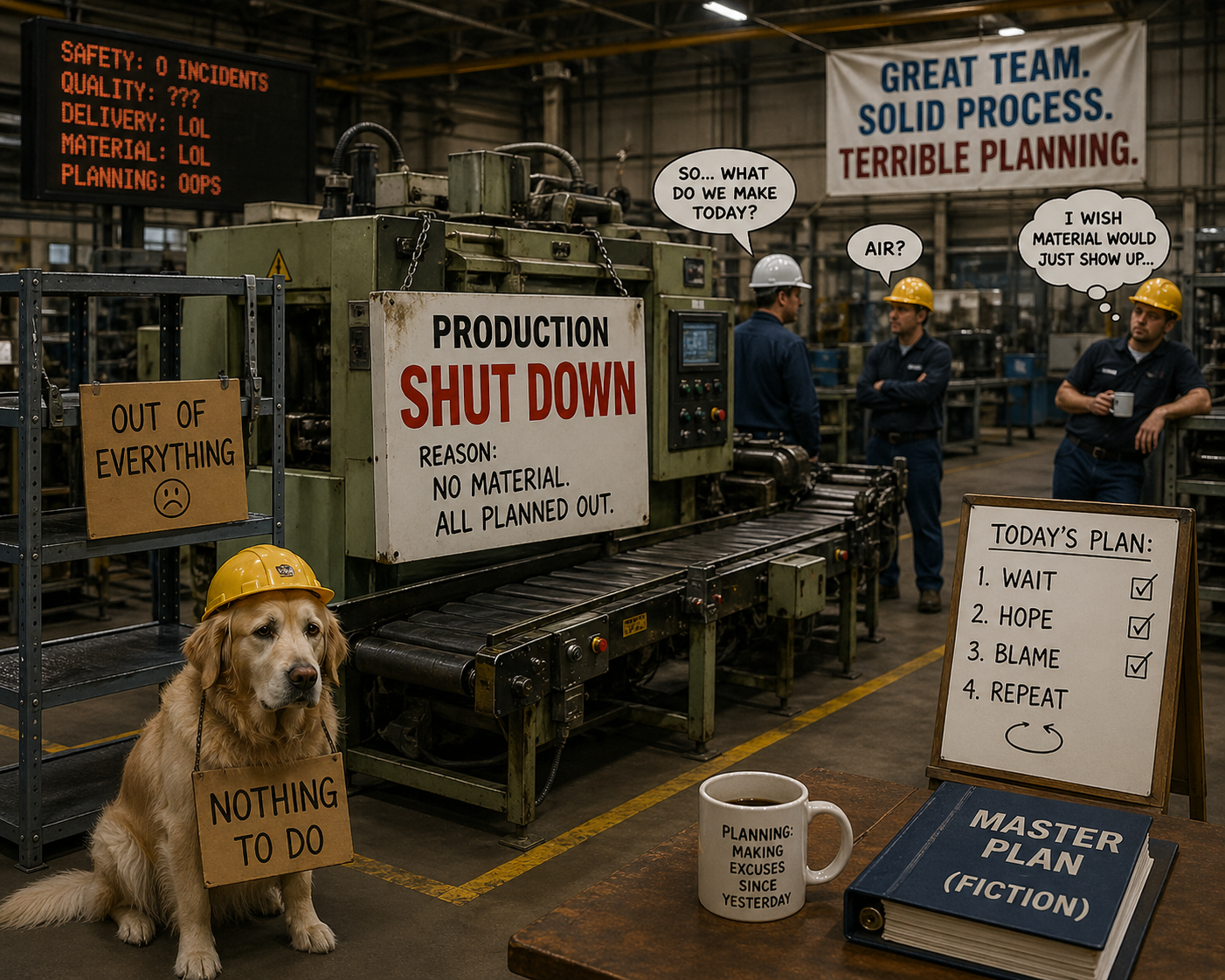
A mid-sized industrial equipment manufacturer was dealing with recurring production stops caused by shortages on a few machined components. The response was familiar. Safety stock was increased on those parts to prevent future disruptions.
Within a quarter, inventory for those items had nearly doubled. The shortages didn’t go away.
When the team actually reviewed the data, demand was not the issue. Consumption was stable. The problem was lead time. The system showed a three-week supplier lead time, but actual deliveries ranged from three to six weeks depending on supplier capacity and batching.
Safety stock was being used to cover demand variation. The real problem was supply variation.
Once the team corrected the lead time assumption and sized the buffer around actual supplier performance, the situation stabilized. Production interruptions reduced, expediting dropped, and inventory levels stopped fluctuating unnecessarily.
Nothing about the math changed. The inputs did.
Where Overcomplication Creeps In
This is usually the point where things get unnecessarily complicated. Safety stock turns into a formula-driven exercise with layers of statistical logic. Standard deviation, service levels, distribution assumptions. The spreadsheet looks impressive, and the output feels precise.
The problem is that precision does not help if the inputs are off.
If your system shows a 14-day lead time but suppliers consistently deliver in 18, the calculation is already wrong. If demand data includes one-time spikes without context, the buffer becomes inflated. The model looks clean, but it is built on assumptions that do not match reality.
That is when safety stock becomes harder to trust, not easier.
What Actually Improves It
The biggest improvements come from tightening the connection between the number and what is actually happening in the system.
Focus on the basics that matter. Make sure lead times reflect real supplier performance, not outdated assumptions. Separate normal demand from exceptional events so you are not building buffers around anomalies. Treat items differently based on how they behave instead of applying one rule across everything.
These are not complicated changes, but they have a disproportionate impact. When inputs improve, even a simple approach to safety stock becomes effective.
What It Looks Like When It Works
When safety stock is set correctly, it becomes almost invisible. It is not something that needs constant adjustment or attention. Inventory levels feel intentional, and shortages become occasional rather than routine.
More importantly, the number can be explained. It is tied to how the system behaves, not how someone feels about recent performance. That is usually the clearest sign that it is working.
Conclusion
Safety stock is often treated like a calculation problem, but it is really a reflection problem. It reflects how well you understand variation in your system and how consistently you respond to it. You do not need complex models to get it right. You need clear inputs, practical thinking, and discipline in applying it over time.
Because safety stock is not about predicting the future.
It is about making sure the future does not catch you unprepared when it inevitably refuses to follow the plan.
