
Design Looks Great on CAD. Now Try Building It: The Reality of Manufacturing Constraints
Every design looks great in CAD. Geometry is perfect, tolerances are clean, and everything aligns exactly the way it should. You can rotate the model, zoom in, run simulations, and convince yourself this is ready.
Then it hits manufacturing.
Suddenly, the part needs a fixture that does not exist. A tolerance that looked harmless now requires a process nobody planned for. A supplier comes back with a quote that feels like it includes emotional damage. Nothing is technically wrong with the design. It just has not met reality yet.
This is where most problems begin, not in design quality, but in the gap between design intent and manufacturing capability.
Engineering Optimizes Design. Manufacturing Optimizes Reality
Engineering is built to optimize performance, fit, and function. Manufacturing is built to optimize repeatability, cost, and throughput. Both are correct, but they are solving different problems.
CAD does not worry about tool access. Machines do. CAD does not think about setups. Production does. CAD does not care how a part is held during machining. That becomes a problem the moment the first unit hits the floor.
This is where Design for Manufacturing is supposed to close the gap. In practice, it often shows up late, usually after design is already locked and someone asks, “can we actually make this?”
The answer is almost always yes. It just costs more, takes longer, and creates more complexity than expected.
Where Designs Start Breaking Down
The issues are rarely dramatic. They show up as small decisions that compound.
Tolerances are one of the first places things drift. In CAD, tightening a tolerance is easy. In manufacturing, it changes everything. It can mean additional setups, slower machining, tighter inspection, and higher rejection rates. Individually, each tolerance looks reasonable. Combined, they create a system that is difficult to hold consistently.
Tool access is another quiet problem. Features that look simple on screen can become difficult when tools cannot reach them directly. What was modeled as a single operation turns into multiple setups or specialized tooling.
Material selection adds another layer. A material may perform well in theory, but that does not mean it is easy to source, machine, or hold tolerance on. Supplier capability becomes critical here. Not every supplier can process every material with the same consistency, and designs that assume ideal capability often struggle in real conditions.
Then comes part handling, which rarely shows up in design discussions. If a part cannot be held securely, aligned properly, or inspected efficiently, the process becomes unstable. Stability is what manufacturing values most, and instability is expensive.
None of these issues stop a design from being released. They show up later, when changes are harder to make.
Most of the Cost Is Locked Before Manufacturing Even Starts
Up to 70 to 80 percent of a product’s lifecycle cost is effectively determined during the design phase, even though only a small portion of the cost is actually incurred at that stage. By the time manufacturing gets involved, most of the cost structure is already set.
That is why late changes feel painful. They are not just adjustments. They are corrections to decisions that have already shaped the system.
How Small Decisions Turn into Big Problems
What makes this challenging is how small design choices ripple across the system. A slightly tighter tolerance increases machining time. Increased machining time reduces throughput. Reduced throughput extends lead time. Longer lead times push teams toward expediting and higher inventory.
The same pattern shows up across other areas:
• Complex geometries increase setup time and variability
• Hard materials slow down processing and increase tool wear
• Limited supplier capability introduces inconsistency across batches
None of these decisions are wrong on their own. They just are not isolated. Manufacturing turns every decision into a system level impact.
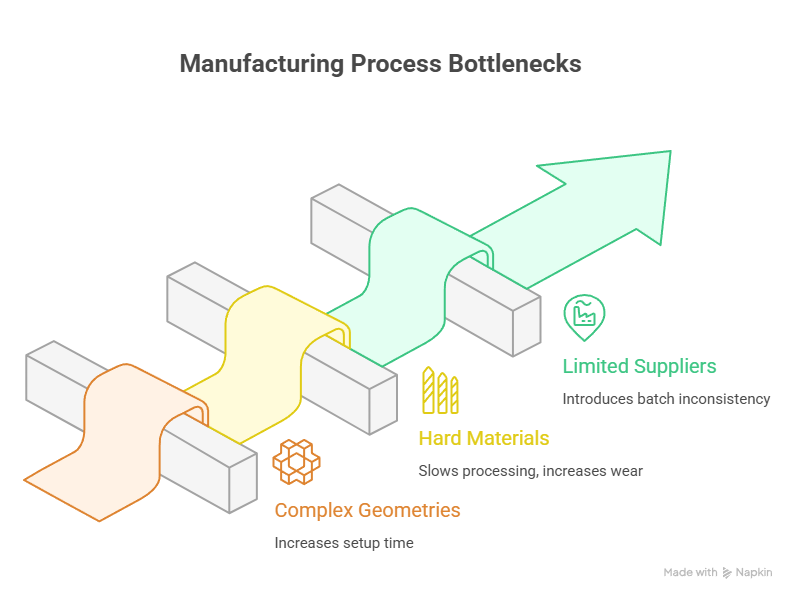
This is how designs that look efficient on screen become expensive in production without any major redesign.
What Actually Works in Practice
The solution is not to simplify every design or restrict engineering creativity. It is to align design decisions with manufacturing reality earlier.
Design for Manufacturing works when it is applied early, not as a review step but as part of design thinking. Tolerances are defined based on process capability, not just functional preference. Supplier capability is understood before finalizing materials and processes, not after the first quote comes back higher than expected.
The most effective teams bring manufacturing and suppliers into the conversation early. Not to slow things down, but to prevent downstream friction. A small adjustment in design at the right time is far cheaper than a correction during production.
It is not about designing what is easiest to make. It is about designing what can be made consistently.
Conclusion
Design does not fail in CAD. It fails when it meets manufacturing, where assumptions get tested against real constraints. The gap is not about technical capability, but about alignment. Engineering focuses on intent, performance, and function, while manufacturing is responsible for turning that intent into something repeatable, stable, and cost-effective.
When those two are not connected early, the system absorbs the difference later through rework, delays, higher costs, and unnecessary complexity. By the time those issues surface, most of the decisions that caused them are already locked in, making corrections slower and more expensive than they need to be.
A strong design is not just one that works in theory, but one that holds up in production without constant adjustments. That difference does not come from better tools or more detailed models. It comes from understanding manufacturing constraints early and designing with them in mind.
